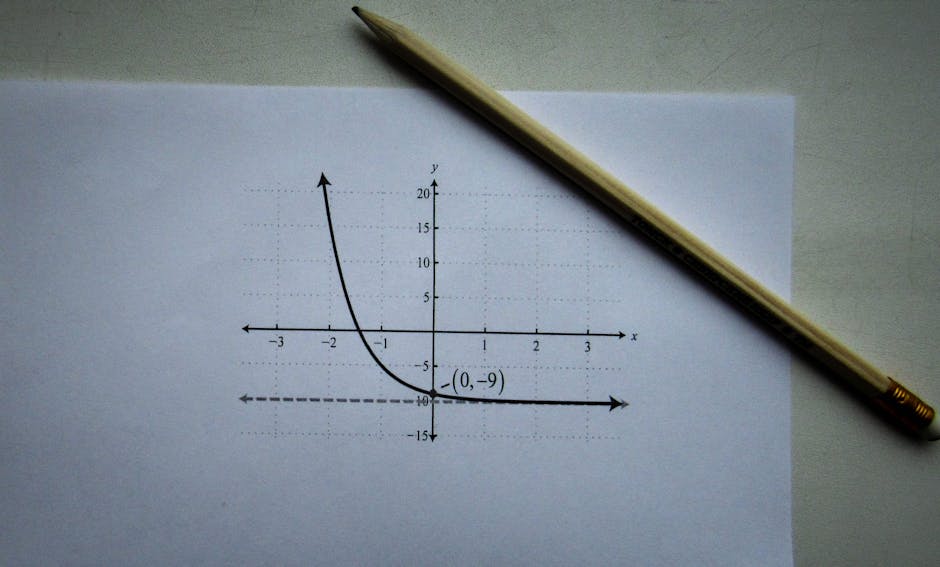
Quadratic functions are one of the most important foundations in algebra. Once you truly understand them, a huge range of other problem types become much more approachable.
General form
A quadratic function takes the form:
Its graph is a parabola — opening upward when , downward when .
3 important representations
1. Standard form
Easy to identify coefficients and find the -intercept at .
2. Vertex form
The vertex of the parabola is at . Makes it easy to spot the maximum or minimum value.
3. Factored form
Used when the two roots are known. Immediately reveals the -intercepts.
Formulas you must know
-coordinate of the vertex:
-coordinate of the vertex:
Discriminant:
- : two distinct real roots
- : one repeated root
- : no real roots
Quick graphing technique
To sketch a parabola accurately, just identify 5 points:
- Vertex
- -intercept:
- The point symmetric to across the axis of symmetry
- -intercepts (if any):
The axis of symmetry is the vertical line .
Real-world applications
Quadratic functions describe many natural phenomena:
- Physics: projectile motion, free fall under gravity
- Engineering: suspension bridge design, parabolic antennas
- Economics: revenue optimization, break-even analysis
Example: A ball is thrown upward with initial velocity m/s from height m. Its height over time:
The vertex gives the maximum height and the time at which it occurs.
Practice with MathPal
Take a photo of your quadratic function problem and send it to MathPal — the AI will work through it step by step: finding the vertex, sketching the graph, solving the equation, with clear explanations at every stage.